
The Prep Gap
Most DIY failures come from skipped or inadequate surface prep. A kit coating applied over concrete that wasn't mechanically profiled, that still has curing compounds, or that has moisture pushing through won't bond — and it peels. Professional prep mechanically opens the surface so the coating bonds to sound concrete.
Materials and System
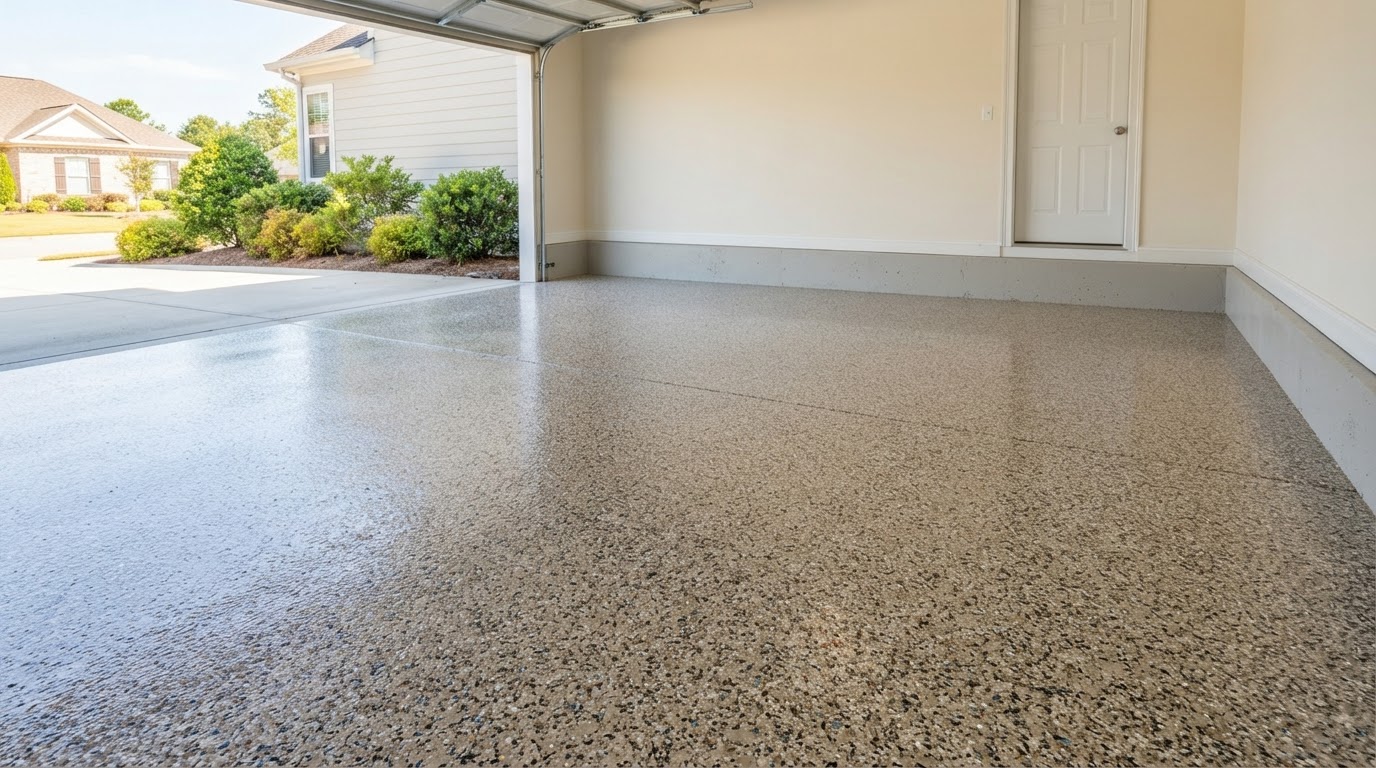
Store kits are typically a single thin coat, not a multi-layer system. A professional flake system is a base coat, a flake broadcast, and a clear topcoat — a real system built for the traffic and wear a garage creates. The materials and the build are different, and so is the lifespan.
What Can Go Wrong
Hot-tire pickup, moisture bubbling, and early peeling are the classic DIY failures. Each traces back to prep or to a thin coating asked to do a job it wasn't built for. A failed DIY floor often costs more to fix — strip and redo — than doing it right the first time.
The Real Value
A professional installation costs more upfront but is built to last. The investment goes into the prep, the materials, and a system specified for the space — not a thin film that fails after a season. When you factor in the cost of redoing a failed DIY floor, professional installation is often the better long-term value.
DIY Kit vs. Professional Installation at a Glance
| Feature | DIY Kit | Professional Installation |
|---|---|---|
| Surface prep | Often minimal or acid etch only | Mechanical profiling of the concrete |
| System | Single thin coat | Multi-layer base, flake, topcoat |
| Durability | Months to a few years; peeling common | Built for the traffic and wear |
| Cost | Lowest upfront | Higher upfront, longer lifespan |
| Risk | Hot-tire pickup, bubbling, early failure | Specified to the slab and conditions |